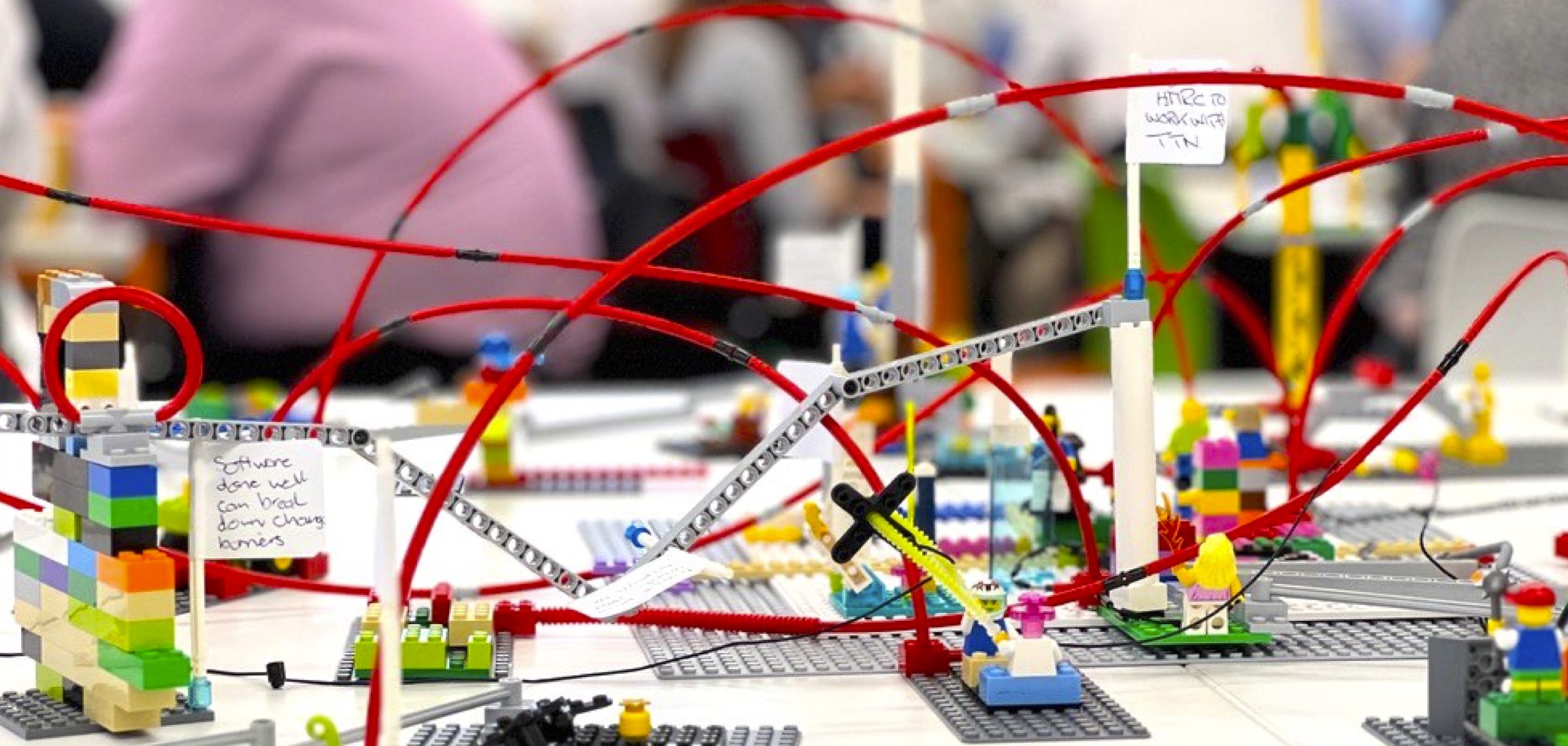

- What it is
- A facilitation method in which people answer a question by building a model with LEGO® bricks, then explain what it means.
- Where it came from
- The LEGO Group, working with Professors Johan Roos and Bart Victor of IMD, in the late 1990s.
- Who owns it
- Open source since 2010, under a Creative Commons licence. The name is a trademark of the LEGO Group.
- How it runs
- Four steps every time: pose the question, build, share, reflect.
- How deep it goes
- Three build levels: individual, shared and system models. System models follow SeriousWork's five-stage model.
- Certification
- Not required by law, and no single body certifies. Choose training by what it makes you able to do.
What it is
Everyone builds. Everyone speaks.
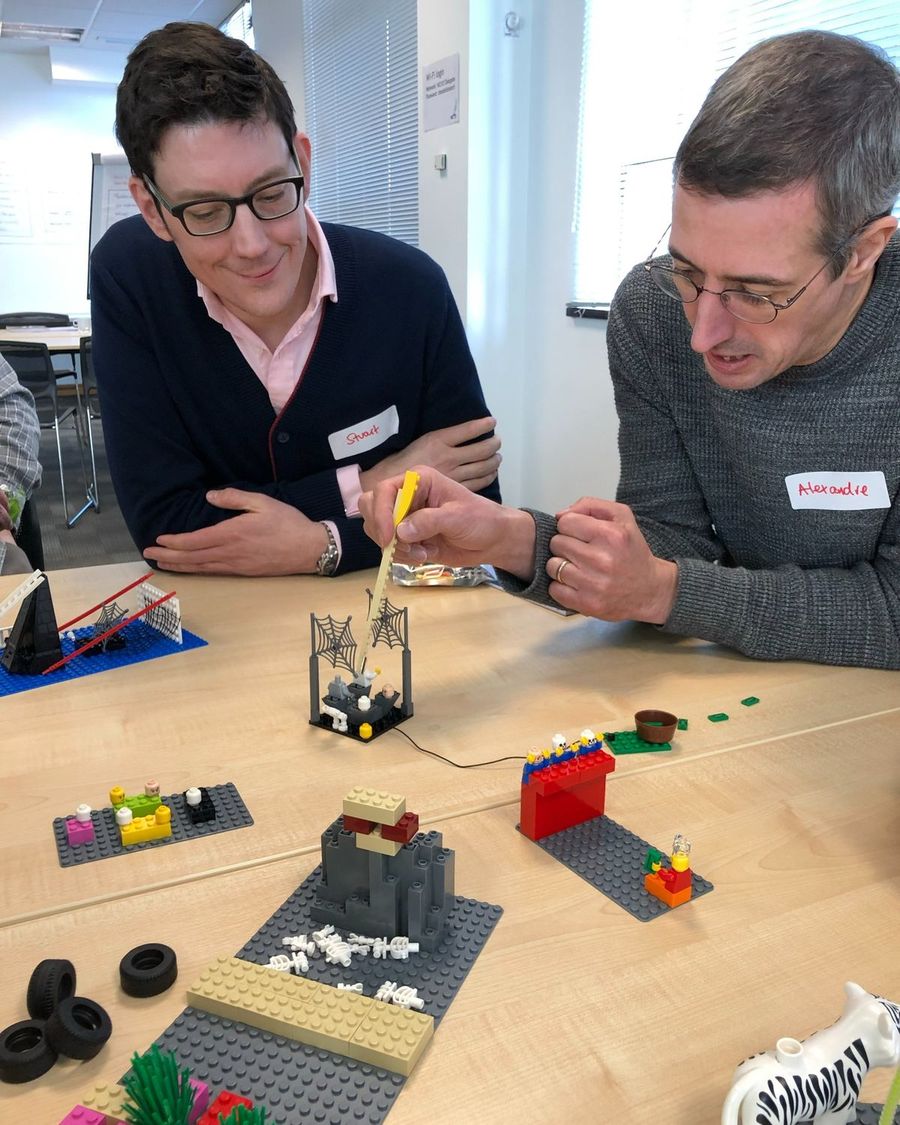
The LEGO® Serious Play® method is a way of facilitating groups. The facilitator asks a question, each participant answers it by building a model with LEGO® bricks, and then explains what the model means.
Because everyone builds and everyone speaks, the conversation draws on the whole room rather than the loudest voices. Practitioners sometimes call this 100/100: everyone contributes, all of the time. Ideas that are hard to put into words become something people can point at, question and change.
The bricks are not the point. They are a language. A tower might mean ambition to one person and isolation to another, and only the builder decides. That rule, the builder owns the meaning, is what makes it safe for a senior team to be candid.
SeriousWork has trained 3,000+ people in 21 countries, and its founders have written five books on the method.
Where it came from
From a boardroom problem to an open method.
The method was invented to help leadership teams do better strategy. It became open source in 2010, which is why it is now used, and taught, all over the world.
- Late 1990s
Invented for strategy
The LEGO Group works with Professors Johan Roos and Bart Victor of IMD in Lausanne on a better way for leadership teams to imagine strategy.
- 2010
Open source
The LEGO Group publishes the method in an Open Source Guide under a Creative Commons licence. Anyone may use it, within the LEGO Group's trademark guidelines.
- 2015 and 2016
SeriousWork begins
Sean Blair and Marko Rillo meet in Billund and write SERIOUSWORK, a practical how-to book launched in London in November 2016.
- 2020
Online
SeriousWork develops techniques for running the method online, with more than 254 people, published as How to Facilitate LEGO® Serious Play® ONLINE.
- Build Level 3
System models
Mastering the LEGO® Serious Play® Method sets out 44 techniques, and system models become SeriousWork's specialism.
- 2026
The Systems Synergy
Sean Blair integrates the method with The Fifth Discipline and Bohmian Dialogue. Bart Victor writes the foreword.
“Ultimately, the most important shift described here is from method to capability.”
The core process
Four steps, every time.
Every LEGO® Serious Play® activity, from a five-minute warm-up to a system model, runs the same four steps. Walk through them with a real question.
Pose the question
The facilitator asks a question with no obvious answer, and sets a short build time.
“Build a model of your team at its best.”
Good questions are open, specific and about something the group cares about. A weak question produces polite models.
Build levels
From one model to a whole system.
Individual models
Build models alone to share 3D prints of your thoughts, so others can see and understand your thinking. Covered in SERIOUSWORK, our first book.
Shared models
Build shared models to create mutual understanding on topics of common interest: a shared vision, values or strategy. Covered in Mastering the LEGO® Serious Play® Method.
System models
Build system models to understand the forces, dynamics and impacts of and in systems, using the five-stage SeriousWork Systems Thinking Model©. SeriousWork's specialism.
System level
Five stages to think in systems.
At Build Level 3, SeriousWork facilitators follow the SeriousWork Systems Thinking Model©: five stages that take a group from a shared purpose to a system model it can use. It is taught on our Advanced course and on Build Level 3.
A system is an interconnected set of elements that is coherently organised in a way that achieves something.
Shared Model
‘Achieve something’
The group builds a shared model of what the system is there to achieve. Every system achieves something, so this is where the work starts.
The SeriousWork Systems Thinking Model© is SeriousWork's own, developed by Sean Blair. The core process is described in the LEGO® Serious Play® Open Source Guide, © 2010 The LEGO Group.
Why it works
Serious play is still play.
The method draws on ideas about learning and play that are older than the bricks. Four do most of the work.
Thinking with your hands
Seymour Papert's constructionism holds that people learn especially well when they build something tangible. Building slows thinking down, so people find out what they think rather than repeating what they planned to say.
Metaphor
George Lakoff and Mark Johnson showed that we think in metaphors. A model makes a metaphor visible, so a few bricks can carry a complex idea, and people discuss the model rather than each other.
Storytelling
Explaining a model turns it into a story. Stories carry meaning that bullet points flatten, give every person a voice, and are remembered long after the meeting.
Flow
Mihaly Csikszentmihalyi's flow is the state of full absorption when challenge matches skill. Well-designed build questions put a whole group there together.
In practice
What a workshop looks like.
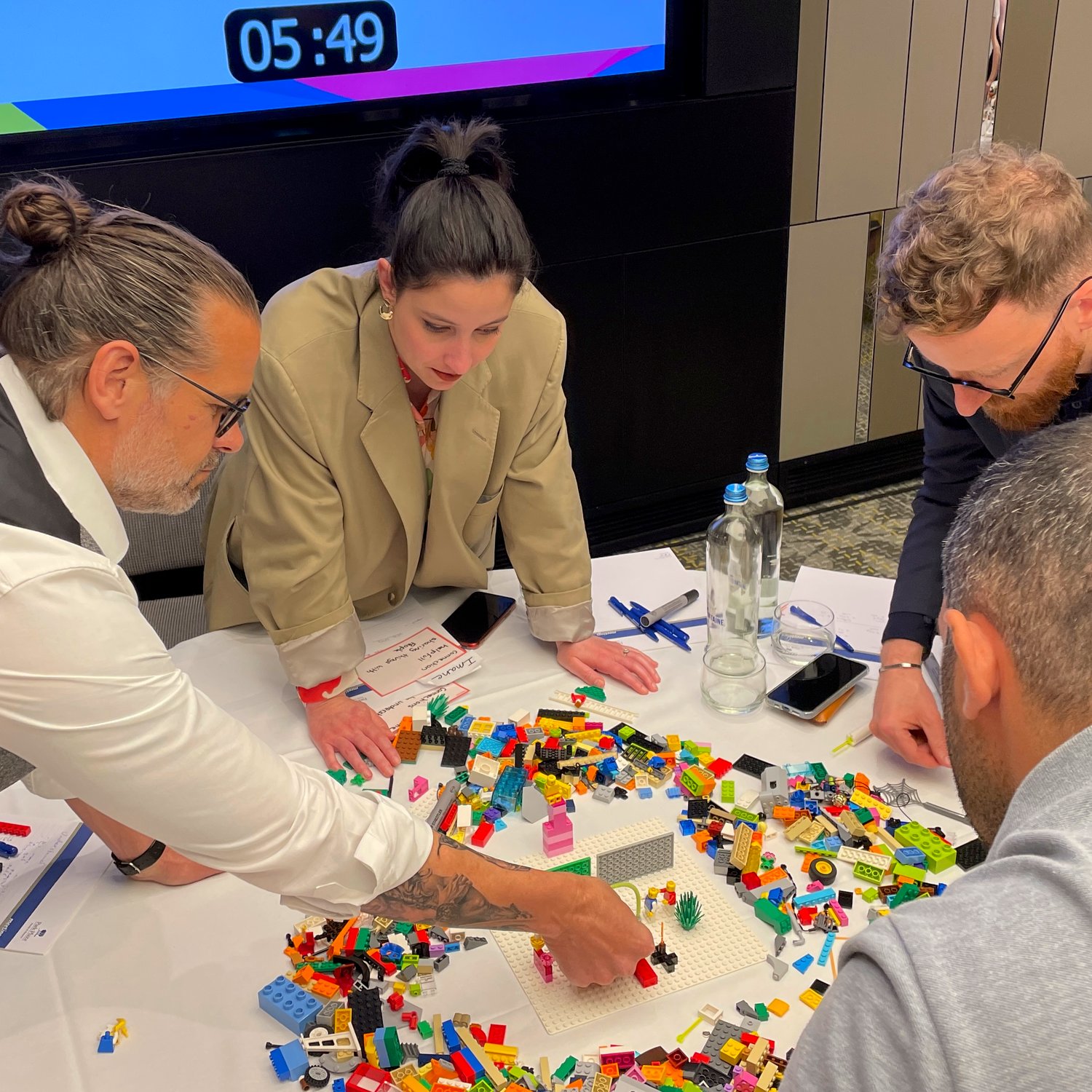
Most workshops run from a half day to two days. A facilitator usually works with a table of up to about a dozen people; larger groups work at several tables, with co-facilitators.
The day opens with skills building: short builds that teach everyone, including the sceptics, that they can build and that their model will be heard. The real questions come next, moving up the build levels as trust grows. A workshop ends with something the group made together: a shared model or a system model, photographed and written up.
| A typical meeting | A workshop using the LEGO® Serious Play® method | |
|---|---|---|
| Who speaks | The confident few | Everyone, in turn |
| How ideas appear | Words and slides | Models anyone can point at |
| Disagreement | Between people | Between models, which is safer |
| What is left | Minutes | A model the group built and owns |
Materials. Workshops use dedicated LEGO® Serious Play® materials: small personal starter sets, larger sets for shared models, and connection sets for system models. Online, each participant works with a small kit posted to them in advance.
The craft
The question is the craft.
Every workshop stands or falls on its questions. Here are three, one for each build level, with why each one works and what a facilitator asks next.
Why it works. It asks for something personal and specific, so nobody can hide behind a job title. “Might not see” invites people to show a strength or a worry they would not normally say out loud.
- Which part of your model matters most to you, and why?
- What would the team lose if that part were missing?
Why it works. Every person’s contribution is literally built into the shared model, so every voice counts. Agreeing where each part goes makes the group negotiate what matters most.
- What is at the centre of our model, and how did it get there?
- What is missing that this team would need?
Why it works. It moves the conversation from who we are to the system around us. The connections show cause and effect, which is where the insight, and the leverage, usually sits.
- If we strengthened one connection, which would make the biggest difference?
- What happens elsewhere in the system when this one changes?
What the three have in common. Each is open, so there is no right answer to build. Each is specific to this group. Each is about something the group cares about. And each is easier to build than to say, which is the point.
Try more: build a question sequence for your own purpose and group
- 1 · Opening question
“Build a model of our organisation as our best customers experience it today.”
Low risk, quick to build. Everyone finds their voice.
- 2 · Deepening question
“Build what success looks like for us in three years’ time.”
Goes beneath the surface. Give a little more time.
- 3 · Action question
“Build the one thing standing most in the way of that future.”
Turns insight into something people will do.
With a new group, start with a few minutes of skills building so everyone learns to build and tell a story before the real questions. Then, for every model: ask about the model, never the person.
- Five tests appear here as you type.
Where it's used
Wherever the answer is already in the room.
Three cases from Serious Outcomes, our sister consultancy, where Sean leads strategy and culture work with senior teams using the method. Each case is published in full on its site and in The Systems Synergy.
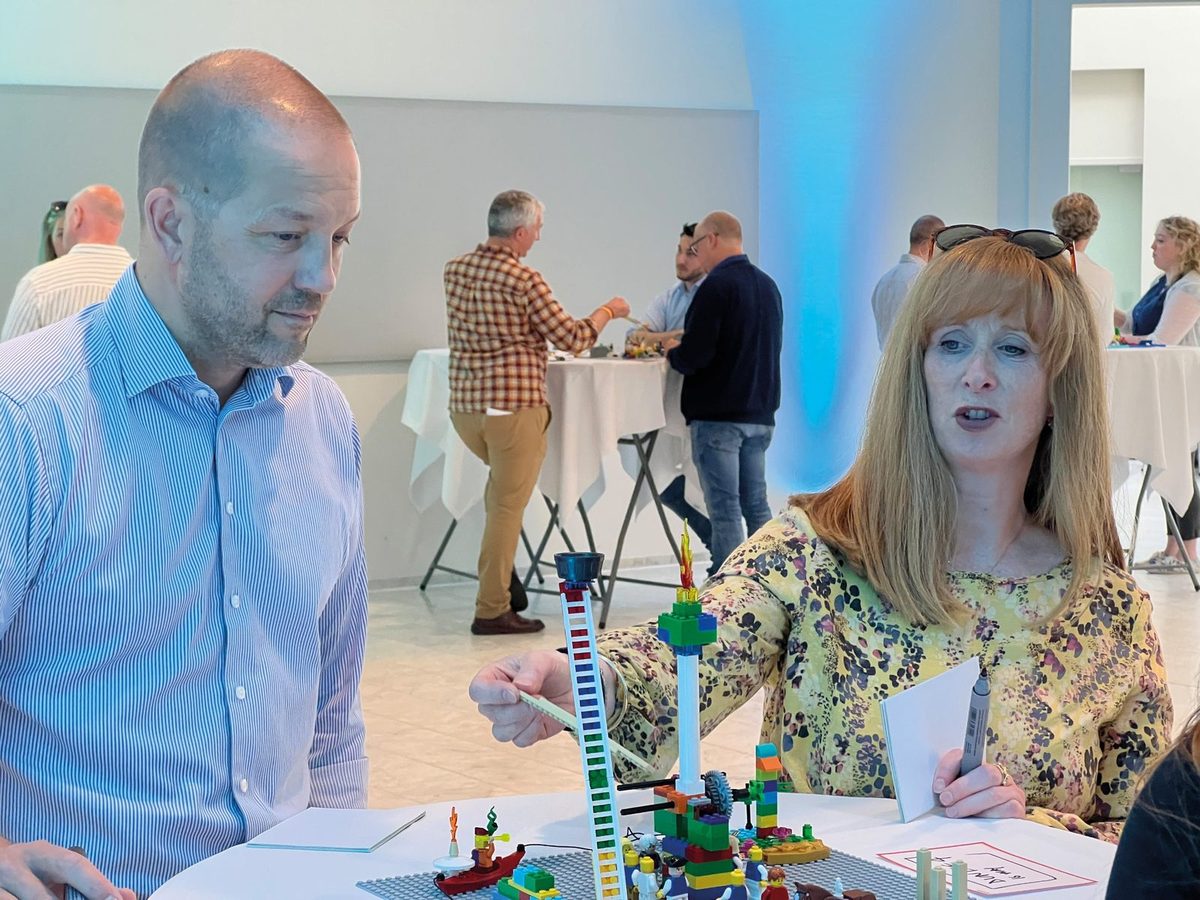 Strategy · 2022
The Insights Group
Engagement with strategy at scale, across the organisation.
Read on Serious Outcomes ↗ (opens in a new tab)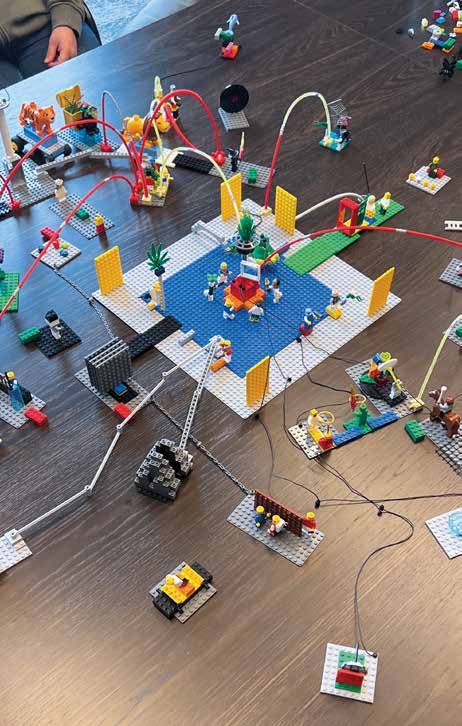 Systems · 2023
Spark Inside
A criminal justice charity building a shared vision for Dialogue in prisons, then mapping the forces that would help or block it.
Read on Serious Outcomes ↗ (opens in a new tab)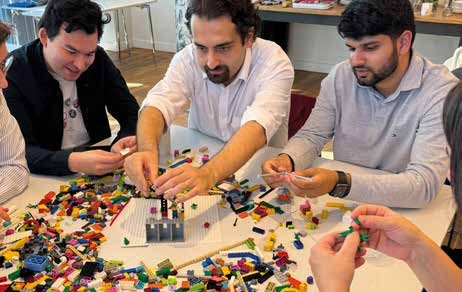 Strategy · 2024
Oxera
One shared vision for a data science practice, and the two priorities to act on first.
Read on Serious Outcomes ↗ (opens in a new tab)SeriousWork clients include Google, HSBC, Pfizer, the UK Cabinet Office and the US Space Force.
Certification
Is there an official certification?
No. Since the method became open source, no single body owns certification, and the LEGO Group does not certify or endorse facilitators. Many organisations train and certify, and their courses differ widely.
So compare what a course makes you able to do: how much you practise with real groups, which build levels it covers, whether the trainers wrote the material, what support follows, and what independent reviews say.
To make that comparison easier, we publish the standard we certify to, for each of our three credentials: the SeriousWork Facilitator Standard. It is free to use, whoever trained you.
Glossary
The words practitioners use.
Show the full glossary (57 terms)
The method
- LEGO® Serious Play® method
- A facilitation method in which people answer a question by building a model with LEGO® bricks, then explain what it means. Everyone builds and everyone speaks.
- LSP
- Practitioners’ shorthand for the LEGO® Serious Play® method. Common in searches and job titles, though the LEGO Group’s own materials use the full name.
- Serious play
- Using play deliberately to work on real issues, so people think and speak more freely about things that matter. The idea behind the method, set out by Johan Roos and Bart Victor at IMD in the late 1990s.
- Purposeful play
- Play chosen for a reason: to learn, decide or create something that matters. It keeps play’s freedom and energy while aiming it at a real outcome.
- Open Source Guide
- The LEGO Group’s 2010 publication of the method’s principles and philosophy under a Creative Commons licence, so anyone may use it within the LEGO Group’s trademark guidelines. Read the guide (PDF) ↗
- Certification
- Evidence that a facilitator has been trained and assessed in practice. No law requires it and no single body issues it; the LEGO Group does not certify facilitators.
- 100/100
- The principle that every participant contributes, all of the time, because everyone builds and everyone speaks.
- Builder owns the meaning
- Only the person who built a model says what it means. Others ask about the model, never interpret it.
- Facilitator
- Designs and runs a workshop process that guides a group towards an outcome, while the group owns the content.
- Coach
- Guides individuals or groups through reflective conversations that help them gain clarity and decide what to do.
The process
- Core process
- The four steps that underpin cycles of building in the LEGO® Serious Play® method: question, build, share, reflect.
- Build question
- The question a group builds its answer to; the Open Source Guide calls it the challenge. Good ones are open, specific and about something the group cares about.
- Skills building
- Short opening builds that teach everyone how to build, use metaphor and tell a model’s story.
- Metaphor
- Using one thing to stand for another: a LEGO® model standing for an idea, a relationship or a dynamic. Metaphor lets people say through a model what is hard to say directly.
- Hand-mind connection
- The idea that building with the hands brings out knowledge people did not know they had. Builders often find out what they think while building, not before.
- Simple guiding principles
- Short, memorable rules a group draws from its models to guide decisions and behaviour after the workshop. Often the final step of system-level work.
- Brick Keeper
- A participant nominated to look after a workshop’s models and insights, then bring them back as the starting point of a later workshop, so the group builds on its earlier work rather than starting again.
Levels and models
- Build levels
- Build Level 1: individual model building. Build Level 2: shared model building. Build Level 3: system model building.
- Individual model
- A model one person builds to answer the question in their own way. Build Level 1, and the starting point for every shared and system model.
- Shared model
- One model a group builds together from parts of its individual models, showing a meaning everyone has agreed. Build Level 2.
- Meta-Model©
- One model built by combining several shared models, so the thinking of a larger group, working at several tables, is brought together in a single picture.
- System model
- Models connected into one system, showing how the outcome the system exists to achieve is shaped by its agents and their connections. Build Level 3.
- Systems Thinking Model©
- SeriousWork’s five-stage model for facilitating system models at Build Level 3: shared model, agents, organise, connections, insights.
- Agent
- A single LEGO® model standing for one force, factor, influence or actor in a system. Stage 2 of the SeriousWork Systems Thinking Model©.
- Connection
- The relationship between agents in a system model, shown with LEGO® connector bricks or by placing models close together. Stage 4 of the SeriousWork Systems Thinking Model©.
- Insight stage
- Stage 5 of the SeriousWork Systems Thinking Model©, where the group uses its system model to find insight and decide what to do.
- Real Time Strategy (RTS)
- The original Build Level 3 application of the method, from the early 2000s: a fixed sequence towards three set objectives. The SeriousWork Systems Thinking Model© grew out of it, with more flexibility.
Materials
- Starter Kit
- A small personal set of LEGO® Serious Play® materials, used for skills building and individual models.
- Window Exploration Bag
- A small bag of mixed LEGO® bricks, including window pieces, given to each participant and widely used for skills building and online work.
- Identity and Landscape Kit
- A larger LEGO® Serious Play® set, rich in figures and landscape parts, used to build identities, shared models and landscapes.
- Connections Kit
- Connectors, string and long parts from the LEGO® Serious Play® materials, used to link models in system-level work.
Play and learning
- Magic circle
- Johan Huizinga’s term for the bounded space of play, with its own rules. In a workshop, the safe space that makes candour possible.
- Homo Ludens
- Johan Huizinga’s 1938 book, “Man the Player”, which argues that play is older than culture and underpins law, art and ritual. The source of the magic circle.
- Flow
- Mihaly Csikszentmihalyi’s term for full absorption when challenge matches skill. Well-designed build questions bring a whole group into it together.
- Constructionism
- Seymour Papert’s theory that people learn best by making things they can see and share. It differs from constructivism, Piaget’s broader theory that learners build knowledge from experience.
- Experiential learning cycle
- David Kolb’s four-stage cycle: experience, reflect, conceptualise, experiment. The core process follows a similar rhythm in every build.
Systems
- Systems thinking
- Seeing how the parts of a system connect and influence each other over time, and recognising that its behaviour comes from those relationships, not from the parts alone.
- System
- An interconnected set of elements that is coherently organised in a way that achieves something. Donella Meadows’ definition, and the basis of the Systems Thinking Model©.
- Reductionist thinking
- Breaking a complex problem into parts and dealing with each one separately. Useful for simple problems; misleading when behaviour comes from how the parts interact.
- Feedback loop
- A chain of cause and effect that comes back to where it started, so a change returns to influence itself. The basic building block of systems thinking.
- Reinforcing loop
- A feedback loop that amplifies change in the same direction, producing growth or decline: success breeds success, mistrust breeds mistrust.
- Balancing loop
- A feedback loop that resists change and pulls a system back towards a goal or limit, as a thermostat holds a room’s temperature.
- Delay
- A gap in time between an action and its effect. Delays make systems overshoot and oscillate, and lead people to push harder on things that are already working.
- Emergence
- Behaviour of a system as a whole that none of its parts shows alone, arising from how the parts interact. It cannot be found by studying the parts one at a time.
- Unintended consequences
- Problems created in one part of a system by fixing another, because the system’s connections carry the effect somewhere nobody was looking.
- Leverage points
- Places in a system where a small shift produces large change. Donella Meadows ranked twelve, from changing numbers (weakest) to changing the paradigm behind the system (strongest).
- Mental models
- The deeply held assumptions and images that shape how people see the world and act. One of the five disciplines in Peter Senge’s The Fifth Discipline.
- System archetypes
- Recurring patterns of structure and behaviour, such as Limits to Growth, Shifting the Burden and Tragedy of the Commons. Popularised by Peter Senge in The Fifth Discipline.
- Metanoia
- From the Greek for a fundamental shift of mind: a change not just in what you know but in how you think. Peter Senge uses it for the deepest learning.
- Cynefin
- Dave Snowden’s sense-making framework, which sorts situations into clear, complicated, complex and chaotic so a group can choose how to act. System models suit complex problems.
Dialogue
- Dialogue
- Collective inquiry in which people suspend their assumptions and think together, so meaning comes from the group rather than from individuals arguing positions. From David Bohm’s On Dialogue.
- Suspension
- Holding an assumption or reaction without acting on it straight away, so there is room to examine it together.
- Thinking together
- When a group’s collective intelligence exceeds the sum of its members’ thinking: genuine collaboration rather than individual work coordinated.
- Inquiry
- Asking a question out of genuine curiosity, not as advocacy in disguise.
- Proprioception
- The body’s sense of itself. In Dialogue, noticing a feeling or reaction in your body before, or as, a thought arises.
Systems Synergy
- Systems Synergy
- Sean Blair’s integration of Peter Senge’s Fifth Discipline, the LEGO® Serious Play® method and Bohm’s Dialogue: the models make systems visible, the Fifth Discipline gives the structure, and Dialogue turns understanding into changed behaviour.
- Four human intelligences
- The capabilities that grow through practising the Systems Synergy: individual meaning-making, relational trust, collective wisdom and systems intelligence.
Questions
What people ask.
Drawn from what people actually search for. Short, sourced answers.
What is the LEGO® Serious Play® method?
Do you need to be certified to use the LEGO® Serious Play® method?
How much does certification in the LEGO® Serious Play® method cost?
Who created the LEGO® Serious Play® method?
Is there official certification in the LEGO® Serious Play® method?
What is the magic circle in the LEGO® Serious Play® method?
How long is a workshop using the LEGO® Serious Play® method?
How many people can take part?
Can the LEGO® Serious Play® method be used online?
Can it be used in universities and law schools?
Is the LEGO® Serious Play® method the same as a team-building game?
Becoming a facilitator
Learn to run it from the people who wrote the books.
Two days to certification. Two more to design and run system-level workshops.
Sources and further reading
- The LEGO Group, LEGO® Serious Play® Open Source Guide (2010).
- Huizinga, J., Homo Ludens (1938).
- Lakoff, G. and Johnson, M., Metaphors We Live By (1980).
- Papert, S. and Harel, I., Constructionism (1991).
- Csikszentmihalyi, M., Flow (1990).
- Blair, S. and Rillo, M., SERIOUSWORK (2016).
- SeriousWork, Mastering the LEGO® Serious Play® Method.
- SeriousWork, How to Facilitate LEGO® Serious Play® ONLINE.
- Isaac, L., Building Better Learning.
- Blair, S., The Systems Synergy (2026).
- Roos, J. and Victor, B., “Towards a New Model of Strategy-making as Serious Play”, European Management Journal 17(4), 348-355 (1999). doi.org/10.1016/S0263-2373(99)00015-8
- Roos, J., Victor, B. and Statler, M., “Playing Seriously with Strategy”, Long Range Planning 37(6), 549-568 (2004). doi.org/10.1016/j.lrp.2004.09.005
- Roos, J. and Victor, B., “How It All Began: The Origins of LEGO® Serious Play®”, International Journal of Management and Applied Research 5(4), 326-343 (2018). Free to read: doi.org/10.18646/2056.54.18-025
- Blair, S., The research and theory behind the LEGO® Serious Play® method (2026), with a free paper.