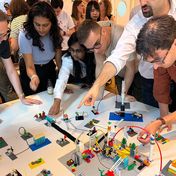
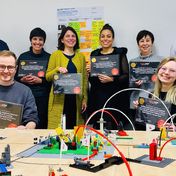
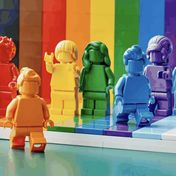
The LEGO® Serious Play® method looks like play, and it is. But it was designed by two management professors who built it deliberately on ideas from learning theory, psychology, linguistics, systems science and strategy. Knowing those ideas makes you a better facilitator: you understand why the process works, so you know when to hold to it and when to adapt.
I first wrote these notes in 2017 for the facilitators we train. This is a revised version: each idea in brief, with the original sources, and then what it means when you are in the room with a group.
Where the method came from
Professors Johan Roos and Bart Victor developed the serious play concept at IMD in Lausanne in the mid-1990s, first with the LEGO Group’s own leaders and then with other leadership teams. They set out the thinking in the European Management Journal in 1999 and, with Matt Statler, in Long Range Planning in 2004. In 2018 they published their own account of how it all began. You can read that story, and links to all three papers, in our brief history of the method.
1. Constructivism and constructionism: we learn by building
Jean Piaget’s constructivism holds that people do not absorb knowledge ready-made. They construct it, fitting new experience to what they already know. Seymour Papert, who worked with Piaget, took this a step further with constructionism: we learn best when we are actively making something tangible in the world, something we can look at, share and talk about.
What it means for facilitators. The method is constructionism in practice: people build, share and reflect, in cycles. That changes your job. You are not there to teach or to solve the problem. You are there to set build questions that are worth answering and to create rich space for reflection, so that individuals and groups use their models to deepen their own understanding.
2. Mental models: making assumptions visible
Piaget also showed that understanding develops as we interact with our environment and revise our internal picture of how the world works. Adults carry those pictures too: assumptions, norms, habits and worldviews that usually stay out of sight.
What it means for facilitators. A model on the table is a mental model made visible. Once it is visible it can be examined, questioned and, where it helps, changed. Encourage people to be curious about their own and each other’s models, and ask what a build might say about the beliefs behind it.
3. Play: free, absorbing and governed by rules
The historian Johan Huizinga argued in Homo Ludens that play is older than culture: a free activity, separate from ordinary life, that absorbs players completely and has its own rules. Lev Vygotsky saw children’s play as imaginative and, crucially, rule-bound. The psychologist Peter Gray distils the research into five characteristics: play is self-chosen, valued for its means more than its ends, guided by rules that leave room for creativity, imaginative, and done in an alert but relatively unstressed state of mind.
There is good evidence that the mood play creates helps adults think. In a classic series of experiments, Alice Isen and colleagues found that people in a mildly positive mood were markedly better at creative problem solving. Roos, Victor and Statler defined serious play as activity that draws on imagination, engages people cognitively, socially and emotionally, and deliberately brings the benefits of play to bear on real organisational challenges.
What it means for facilitators. Play at work is still widely dismissed, which is a great shame and a real opportunity. Part of your role is to legitimise it. The rules of the method, such as everyone builds, everyone tells their story and the model is the answer, are what make play safe and serious at the same time.
4. Motivation: why people lean in
Abraham Maslow’s hierarchy of needs and Frederick Herzberg’s two-factor theory both point to the same truth: beyond pay and conditions, people are motivated by achievement, recognition, competence and the chance to be heard.
What it means for facilitators. For most people, building a model of an idea is absorbing in itself. Sharing it gives everyone an equal voice, and a fuller one, because they communicate visually and with their hands as well as in words. When the topic genuinely matters, such as a team’s shared vision, that combination is highly motivating. Your build questions decide whether the topic matters.
5. Flow: matching challenge to skill
Mihaly Csikszentmihalyi described flow as the state of complete absorption that comes when a task stretches our skills without overwhelming them. Too little challenge brings boredom; too much brings anxiety.
What it means for facilitators. The three build levels offer rising challenge, technically and conceptually. A system model at Build Level 3 is demanding: the physical connections are harder and the field of meaning is much wider. That range lets you design a sequence of tasks that keeps a group in flow as its skill grows, which is one reason skills building comes first.
6. Metaphor: thinking in terms of something else
George Lakoff and Mark Johnson showed in Metaphors We Live By that metaphor is not decoration. It shapes how we think and act. If we speak of argument as war, we try to win arguments rather than understand each other.
What it means for facilitators. Metaphor is built into the method. A single white brick once stood for the running-out of internet addresses: a complex idea held in a simple build. A team asked to build the behaviours that would stop them reaching their vision built a pack of wild wolf dogs to capture a fear of losing control. Help people use bricks metaphorically, and invite them to describe one thing in terms of another, so that key ideas come to life and stay memorable.
7. Imagination: describing, creating and challenging
Drawing on the philosopher Richard Kearney, Roos and Victor’s 1999 paper put three kinds of imagination at the heart of strategy making: descriptive imagination, which sees what is there in a new way; creative imagination, which sees what could be; and challenging imagination, which questions and takes apart what we have built.
What it means for facilitators. A good workshop uses all three. Building the current reality is descriptive; building the future is creative; stress-testing a shared model or a system model is challenging. Design deliberately for each.
8. Learning and change: action, reflection and double loops
Kurt Lewin, a founder of social psychology, pioneered action research and the study of group dynamics. Donald Schön described professional excellence as reflection in action, the artistry of thinking on your feet. With Chris Argyris he distinguished single-loop learning, which corrects the action, from double-loop learning, which questions the assumptions behind it.
What it means for facilitators. These are essential background ideas, especially for facilitators working on organisational change. Reflection questions are where double-loop learning happens: they help groups learn their way out of unhelpful habits and through change, respectfully.
9. Complex adaptive systems: seeing the whole
John Holland described complex adaptive systems as systems with many agents that interact, adapt and learn, so that the behaviour of the whole cannot be predicted from the parts. Emergence, feedback and unintended consequences are the norm.
What it means for facilitators. Build Level 3, the system level, is a powerful way to see, interact with and learn from systems. In 2017 I wrote that this was the subject of a book I hoped to write one day. That book is now The Systems Synergy (2026), and the five-stage SeriousWork Systems Thinking Model© is how we teach it.
10. Strategy: synthesis and emergence
Henry Mintzberg argued that strategic thinking is synthesis, connecting the dots, more than analysis, and that much real strategy emerges from across an organisation rather than being planned at the top.
What it means for facilitators. Mintzberg’s challenge to conventional strategy helped make room for the original "real-time strategy" application of the method, which combined emergence with systems thinking. When you work with leadership teams on strategy, you are helping them synthesise what they collectively know.
What I take from all this
Facilitating since 2000, this is what I conclude from the research and from practice:
- The method rests on robust ideas. It is not a fad, and there are good reasons why it works.
- Building models unlocks insight that abstract thinking alone cannot reach.
- Playful building is intrinsically motivating, and so it is satisfying.
- Seeing, hearing and handling a model together makes communication richer, especially for the listeners.
- Shared and system models put a group into relationship. The conversation that follows tends to be respectful, authentic and focused.
- System models let groups see the unintended consequences of their decisions.
- Skilled facilitation is the key. It is a practice, not a step-by-step technique: a skilled facilitator knows when to intervene and when to step back so that people and groups reach the breakthroughs they are looking for.
Get the paper
A fuller version of these notes, with the complete reading list, is free as a PDF to read, print or share with colleagues.
Sources
- Argyris, C. and Schön, D. A. (1978), Organizational Learning: A Theory of Action Perspective, Reading, MA: Addison-Wesley.
- Csikszentmihalyi, M. (1990), Flow: The Psychology of Optimal Experience, New York: Harper and Row.
- Gray, P. (2013), Free to Learn, New York: Basic Books.
- Herzberg, F., Mausner, B. and Snyderman, B. (1959), The Motivation to Work, New York: Wiley.
- Holland, J. H. (1995), Hidden Order: How Adaptation Builds Complexity, Reading, MA: Addison-Wesley.
- Huizinga, J. (1938), Homo Ludens; English translation 1949, London: Routledge.
- Isen, A. M., Daubman, K. A. and Nowicki, G. P. (1987), "Positive affect facilitates creative problem solving", Journal of Personality and Social Psychology, 52(6), 1122-1131.
- Kearney, R. (1988), The Wake of Imagination, Minneapolis: University of Minnesota Press.
- Lakoff, G. and Johnson, M. (1980), Metaphors We Live By, Chicago: University of Chicago Press.
- Lewin, K. (1946), "Action research and minority problems", Journal of Social Issues, 2(4), 34-46.
- Maslow, A. H. (1943), "A theory of human motivation", Psychological Review, 50(4), 370-396.
- Mintzberg, H. (1987), "Crafting strategy", Harvard Business Review, 65(4), 66-75.
- Papert, S. and Harel, I. (1991), "Situating constructionism", in Harel, I. and Papert, S. (eds.), Constructionism, Norwood, NJ: Ablex.
- Piaget, J. and Inhelder, B. (1958), The Growth of Logical Thinking from Childhood to Adolescence, New York: Basic Books.
- Roos, J. and Victor, B. (1999), "Towards a new model of strategy-making as serious play", European Management Journal, 17(4), 348-355. doi.org/10.1016/S0263-2373(99)00015-8
- Roos, J., Victor, B. and Statler, M. (2004), "Playing seriously with strategy", Long Range Planning, 37(6), 549-568. doi.org/10.1016/j.lrp.2004.09.005
- Roos, J. and Victor, B. (2018), "How it all began: the origins of LEGO® Serious Play®", International Journal of Management and Applied Research, 5(4), 326-343. doi.org/10.18646/2056.54.18-025
- Schön, D. A. (1983), The Reflective Practitioner, New York: Basic Books.
- Vygotsky, L. S. (1978), Mind in Society, Cambridge, MA: Harvard University Press.